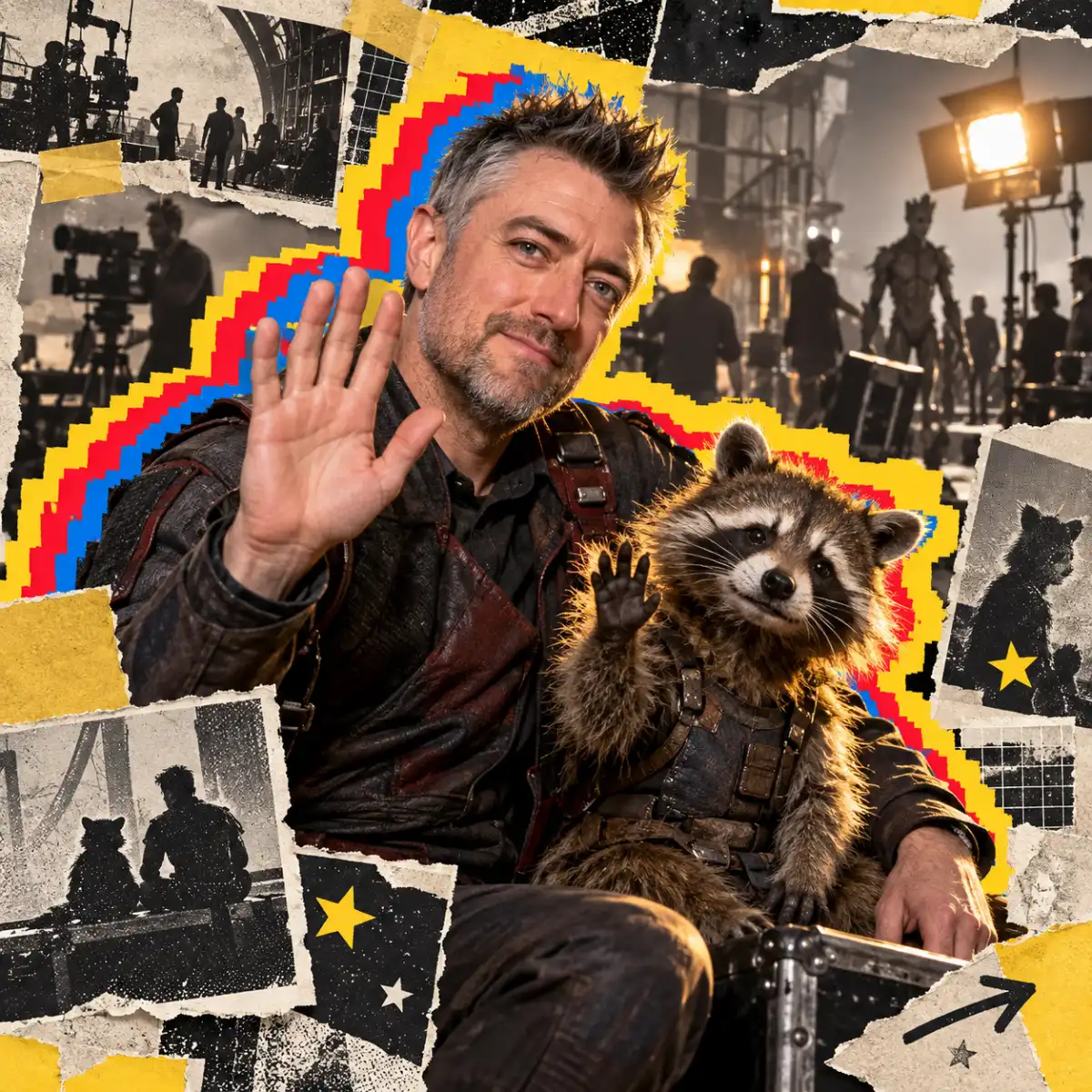
Sean Gunn retires from playing Rocket Raccoon with a very human explanation: his feet and ankles have had enough. After years spent crouching low to provide the character’s on-set performance, the Marvel regular says the physically punishing assignment now “hurts after a while.”
Speaking on The Brandon Davis Show, Gunn said he considers himself finished with that part of the role, although Marvel Studios has not asked him to return.
“Since I’ve turned 50 a couple of years ago, I am retired from playing Rocket,” he said. “Not that they’ve called. But if they did, I don’t think that I could do the motion reference anymore for Rocket. I think I’m too old.”
The interview adds detail to an announcement Gunn had already made at Fan Expo Chicago in August 2025. This is less a surprise Marvel resignation than a fuller account of why his days in Rocket’s signature crouch are over.
Rocket’s performance was harder on Gunn than it looked
Anyone picturing knee trouble can adjust the diagnosis. Gunn said the real strain came from balancing and turning while compressed into a position designed to approximate a small, sharp-moving animal.
“Everyone thinks it’s my knees, but it’s really my feet and my ankles,” he explained. “I’m in a catcher’s crouch, and I’m pivoting a lot on my points of contact with the ground. I’m doing a lot of pivoting in my ankles and feet.”
That repeated movement, he said, gradually affected his body. Rocket may move through space with digital ease, but the actor supplying the physical template still had to perform every turn on an actual set. After more than a decade of that work, the glamour level appears to have settled somewhere near zero.
Gunn’s retirement applies specifically to the demanding on-set reference performance. He did not say Marvel had dismissed him, and both TheWrap and GamesRadar reported that the studio had not contacted him about another appearance. There is also no indication that Bradley Cooper has retired from voicing Rocket or that Marvel has shelved the character.
Motion reference is not quite motion capture
Gunn’s contribution is often described as motion capture, but the production process was more handcrafted than that label suggests. According to the American Society of Cinematographers, he provided motion reference and acting reference, rather than movement data that animators simply transferred onto Rocket.
Visual effects artists studied Gunn’s timing, facial expressions, posture and body language, then created the finished digital performance. Visual effects supervisor Stéphane Ceretti said Gunn acted every Rocket shot in the first Guardians of the Galaxy, giving the animation team a living performance to interpret.
At Fan Expo Chicago, Gunn compared Rocket’s creation to a relay involving several specialists. James Gunn wrote the character, Sean Gunn performed Rocket on set, visual effects teams created the animated raccoon, and Bradley Cooper delivered the familiar voice. No single participant was the entire performance, which is precisely why one retirement does not automatically end Rocket’s screen career.
Sean Gunn also took on a vocal piece of the character’s history. ComicBook.com reported that he voiced young Rocket in Guardians of the Galaxy Vol. 3, including material tied to the character’s painful origin story.
His Rocket résumé reaches beyond three films
The three main Guardians of the Galaxy movies form the center of Gunn’s work as Rocket’s physical reference. The first arrived in 2014, followed by Guardians of the Galaxy Vol. 2 in 2017 and Guardians of the Galaxy Vol. 3 in 2023.
His contribution extended beyond that trilogy. ComicBook.com reported that Gunn also performed Rocket’s on-set reference work in:
- Avengers: Infinity War
- Avengers: Endgame
Visual effects studio Framestore additionally documented his performance for The Guardians of the Galaxy Holiday Special. Taken together, the job covered major crossover spectacles, standalone cosmic adventures and one extremely festive detour.
Gunn was doing double duty across much of this run. In front of the finished camera, he played Kraglin Obfonteri, the former Ravager who gradually became a more central member of the Guardians. Kraglin appeared in all three Guardians films, Avengers: Endgame, Thor: Love and Thunder and the Disney+ holiday special.
Retiring from Rocket’s crouched performance does not necessarily mean Gunn has retired from the Marvel Cinematic Universe altogether. His comments addressed the physical reference work, not Kraglin or every possible future collaboration with Marvel.
Rocket can continue without the crouch
Rocket’s story remains open after Guardians of the Galaxy Vol. 3. The film ended with him leading a new version of the team, placing the former experiment in command rather than sending him into permanent retirement.
That final status gives Marvel a clear route to use Rocket again if the studio chooses. A future appearance could involve Cooper returning to the recording booth, another performer supplying on-set reference, and visual effects artists continuing the character’s digital evolution. None of those plans has been announced, but Gunn’s exit affects only one stage of the process.
The distinction matters because the headlines can sound more final than the facts. Sean Gunn is stepping away from the uncomfortable physical task that helped make Rocket believable. He is not announcing the character’s death, Cooper’s departure or a Marvel decision to dissolve the latest Guardians lineup.
For now, Rocket still has a team to lead, while Gunn gets to stand at full height. After years of ankle pivots in a deep crouch, that may be the most luxurious perk Marvel has ever offered him.