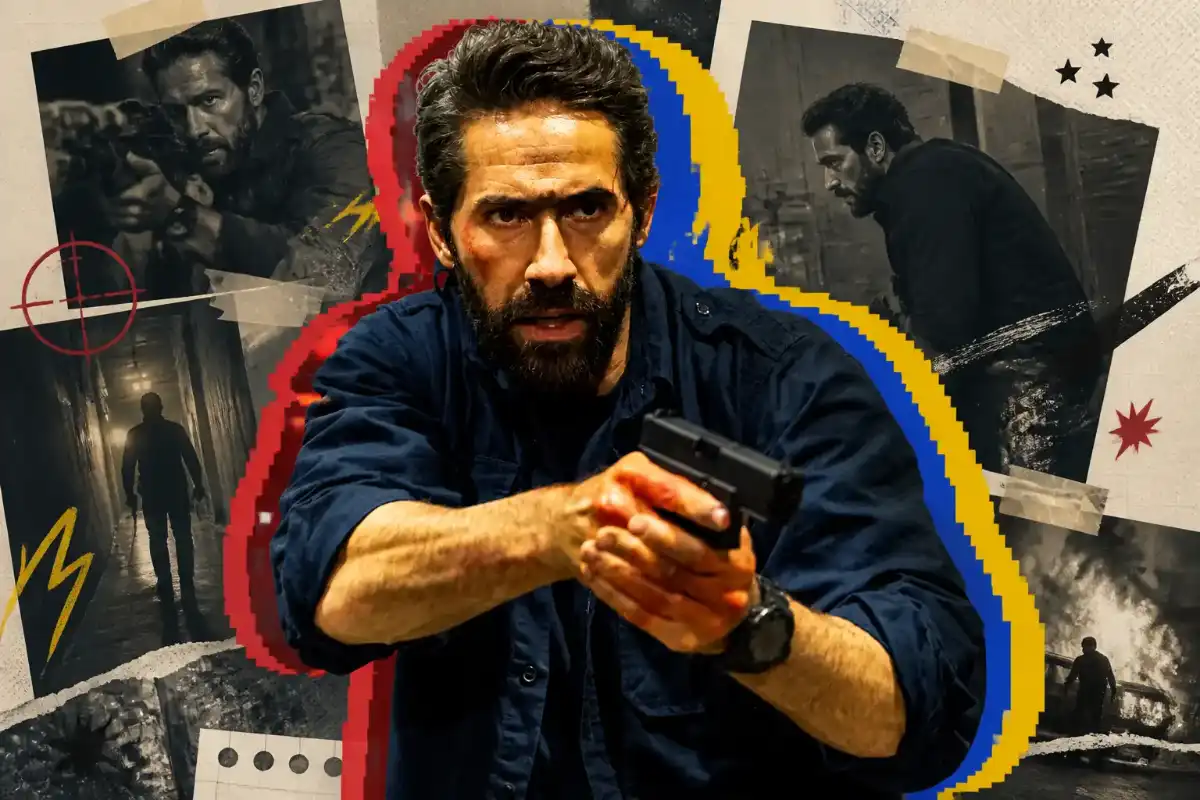
One Last Shot gives Scott Adkins’ covert-action trilogy a suitably breathless finish, but its biggest trick is not the missiles, mercenaries or government secrets. Director James Nunn has built the three films as one extended ordeal, unfolding across roughly four and a half hours in the story’s timeline and presented through long takes and carefully hidden edits. For Navy SEAL Jake Harris, there has been no pleasant break between sequels. The man has barely had time to locate a clean shirt.
Released digitally and on DVD in the United States by Sony Pictures on September 22, 2026, the 97-minute thriller sends Harris into another supposedly unofficial mission. His target is a mercenary force led by Elliot Carter, a former military associate who plans to cripple the United States by shutting down missile defense systems nationwide.
How does the third film continue Jake Harris’ mission?
The new operation arrives only hours after the events of 2024’s One More Shot. Harris is ordered by Admiral Mulholland, played by Dolph Lundgren, to find Carter and stop the attack before the country’s defenses go dark. Steven Cree plays Carter, while Hannah Ware appears as Elena Torres.
Lundgren’s presence gives the finale some heavyweight action pedigree, although Cinapse reported that Admiral Mulholland appears for only a few minutes. He may issue the assignment, but Adkins carries the physical burden, as usual. At this stage, Harris has absorbed enough punishment to make standing upright look like a special effect.
Carter’s scheme was not added at the last minute. Nunn told The Action Elite that the second and third installments were conceived and written together, with elements of Carter’s plan planted in One More Shot. That gives the finale more connective tissue than the standard direct-to-video sequel that simply hands its hero a fresh villain and another warehouse full of armed extras.
Screenwriter Jamie Russell and producer Ben Jacques return behind the scenes, with Nunn once again directing. The result is less a separate adventure than the final movement of a single escalating crisis.
Why do the three movies feel like one continuous film?
The series began with 2021’s One Shot, in which Harris escorts a prisoner from a CIA black site on an island just as armed attackers storm the facility. Its signature was an apparent single-take format, created through extended shots, mobile camerawork and concealed cuts.
One More Shot picked up approximately 12 hours later and moved the action to Washington, D.C. According to Nunn’s interview with Behind the Lens, the third film begins only hours after that sequel. Put together, he estimated that the trilogy tells a story lasting around four and a half hours.
That compressed chronology explains why Harris enters the finale looking exhausted, injured and increasingly frayed. Nunn said Adkins’ visible fatigue was deliberate because the character has had virtually no recovery time. The accumulating damage is not a continuity error or a shortage of movie-star polish. It is the point.
This approach turns the trilogy into an endurance test rather than three neatly reset missions. Harris does not return refreshed whenever a new title card appears. Every wound, failed plan and sleepless hour follows him into the next firefight, making the finale’s physical stakes unusually convincing for a franchise built around spectacular tactical combat.
What makes the action technically different?
The apparent unbroken-take design remains the franchise’s main attraction. Instead of cutting rapidly between angles, Nunn’s camera follows Harris through corridors, rooms and combat zones for prolonged stretches. Hidden edits preserve the illusion that events are unfolding without interruption.
That choice makes each action sequence a logistical puzzle. Performers, stunt teams, camera operators and effects crews must coordinate movement with unusual precision because a mistake late in a long shot can spoil everything that came before it. Adkins’ martial-arts background helps sell the format. His movements can remain visible without the frantic editing often used to disguise less experienced screen fighters.
The technique also places viewers close to Harris’ deteriorating condition. A conventional action movie can cut away, reset the room and return with its hero looking composed. Here, the camera lingers as he struggles, regroups and pushes forward. The format gives the gunfights and hand-to-hand clashes an immediate, game-like momentum without turning Harris into an invulnerable avatar.
That is where comparisons with The Expendables and the Has Fallen films only go so far. All three franchises feature elite operatives, national-security threats and generous quantities of gunfire. The One Shot series operates on a smaller scale, but its continuous-take presentation gives it a technical identity that the larger theatrical brands do not share.
Is One Last Shot really the end of the trilogy?
The title leaves little room for subtlety, and Nunn has described the movie as the conclusion of the trilogy. Cinapse likewise called it the third and final installment. Although another entry has not been formally announced, Nunn told The Action Elite that he expects to work with Adkins again, even if Jake Harris’ marathon assignment has reached its endpoint.
Cree also approached Carter as more than a standard action villain. He said he did not play the character as evil and tried to ground Carter’s cause in an element of truth. For the actor, joining an old-school action production alongside Adkins and Lundgren felt like “Christmas Day as a kid.” The film still delivers a clear hero-versus-mercenary setup, but that performance choice gives the conflict a little more weight than a basic countdown plot.
Early critical reaction has been limited and cautiously positive. Rotten Tomatoes listed only two reviews as of September 24. Debbie Lynn Elias praised the film’s “technical bravura” and tension, while Blu-ray.com critic Brian Orndorf awarded it a B-minus, arguing that Nunn showed some fatigue and generated less excitement than before. Cinapse admired the camerawork and action but criticized the derivative plot, pacing, casting and political messaging.
No box-office or streaming-performance figures have been reported. For now, the movie’s clearest achievement is formal rather than commercial: three releases made five years apart have been stitched into one punishing, near-continuous night for Scott Adkins’ battered hero. Jake Harris finally reaches the end, and sleep has rarely looked more deserved.