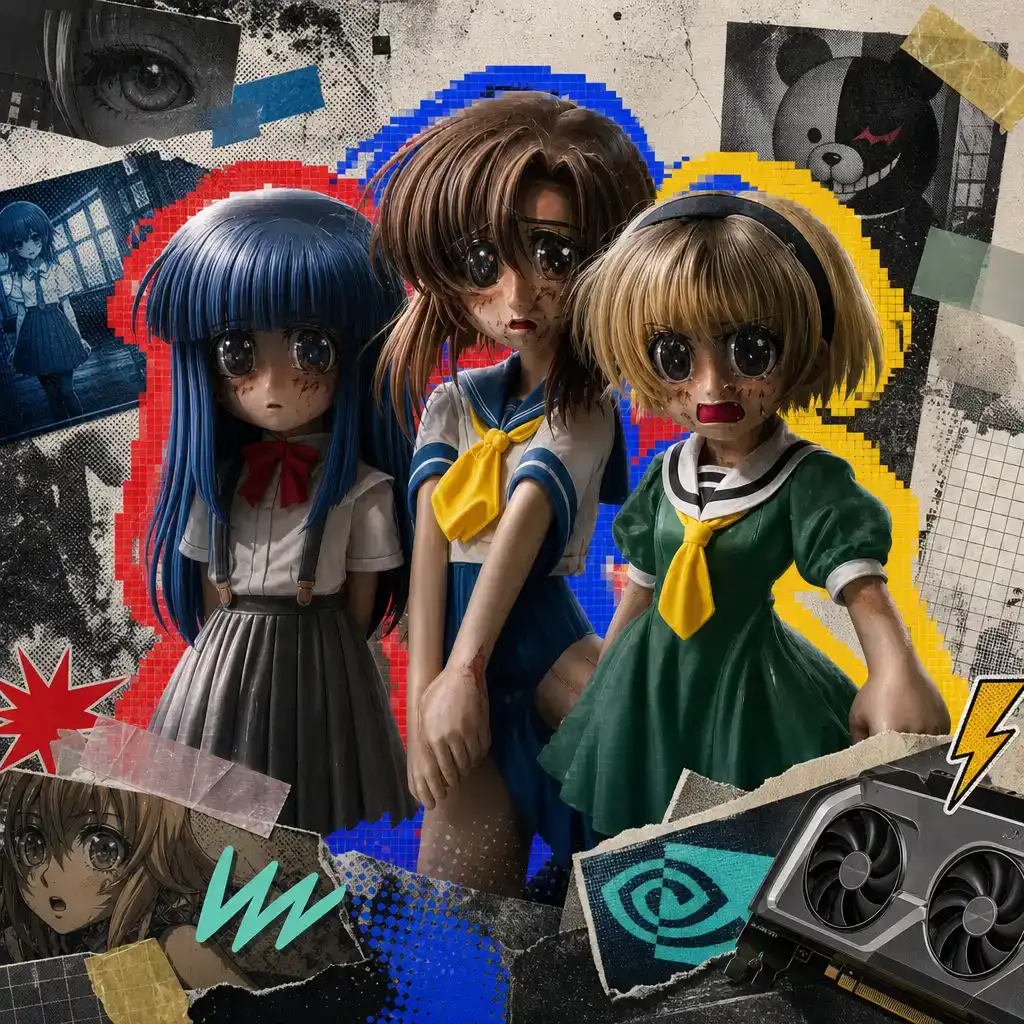
Higurashi When They Cry produces an even more intense transformation. Ryukishi07’s visual novel already mixes sweet character art with psychological horror, so adding realistic textures pushes Rena and Mion deep into uncanny territory. Hair, hands and facial details become more lifelike without becoming more natural. Jo summarized the experience neatly: “I am trapped in a hell of my own creation.”
The images are undeniably striking, but they mostly demonstrate what happens when a realism-focused tool meets artwork that never requested realistic treatment.
Are these images a fair demonstration of DLSS 5?
Not really. PC Gamer reported that users were inserting the leaked runtime into unsupported games, while Tom’s Hardware traced the leak to a 158MB file named nvngx_dlssnr.dll inside an NBA 2K27 early-access build.
Nvidia’s official approach is more controlled. In a technical description published September 1, the company said its new system uses a deterministic, one-step diffusion model. It draws guidance from rendered frames, motion vectors, temporal information and artistic controls selected by developers.
Those controls are the key difference. Nvidia says studios can integrate and tune the technology to protect the intended geometry, textures and visual identity of their games. Jo’s experiments skip that careful production process and let the leaked model loose on finished artwork.
Nvidia chief executive Jensen Huang has called the technology “the GPT moment for graphics.” Addressing criticism that generated details could amount to “AI slop,” Huang told Tom’s Hardware that such claims were “completely wrong,” arguing that developers remain in charge of the underlying assets and presentation.
The anime makeovers therefore reveal the risks of uncontrolled implementation more clearly than they show the intended product. They are less a showroom demo and more a graphics laboratory with the safety signs temporarily removed.
What does DLSS 5 cost in performance?
Realistic pores do not arrive free. Early unofficial testing suggests the leaked technology can place a heavy burden on current hardware.
Tom’s Hardware reported that an experimental implementation in Control reduced an Nvidia GeForce RTX 5070 Ti’s frame rate at 4K from 71 frames per second to 35. The publication cautioned that the settings and internal rendering resolution were not fully documented, so the figure should not be treated as a definitive benchmark.
Modders also patched incompatible instructions to make the runtime operate on GeForce RTX 40-series graphics cards. Tests involving older Ampere hardware were considerably rougher, frequently dropping into single-digit frame rates.
Those results underline why Nvidia is limiting official launch support to its Blackwell-based GeForce RTX 50-series hardware. Unofficial backports may run, but “run” is doing generous work when the frame counter starts resembling a quiet dinner reservation.
For players, the practical questions will be whether supported implementations preserve each game’s art direction and whether the visual gains justify the performance cost. Screenshots can supply instant spectacle. Smooth gameplay still has to survive the makeover.
When does Nvidia officially launch the feature?
Nvidia has scheduled the official debut for September 3 at 9 p.m. Pacific in NBA 2K27. Initial access will be limited to:
- GeForce RTX 50-series desktop PCs
- GeForce RTX 50-series laptops
- GeForce NOW Ultimate
The basketball game should provide a far more representative test than an unauthorized trip through Hope’s Peak Academy. NBA 2K27 was built around realistic athletes, arenas, lighting and materials, giving the neural rendering system source material much closer to its intended use.
That does not make the anime experiments irrelevant. They offer a vivid warning about applying photorealistic generation without respecting a game’s original visual language. Danganronpa’s sharp graphic design and Higurashi’s deceptively cute illustrations work because artists made specific choices. More detail is not automatically better detail.
For now, jo’s collection remains a fascinating gallery of technology doing exactly what it was asked, rather than what the characters deserved. The official rollout will show whether developer supervision can keep the impressive machinery focused and the nightmare faces safely off campus.